🕯️ Korean Chuseok
Korean Chuseok is the regional form of Ghost Festival in South Korea · Gyeonggi-do, centered on welcoming and sending spirits, lamp offerings, family remembrance rites.

- welcoming and sending spirits
- lamp offerings
- family remembrance rites
- offering fruit
- rice cakes
- family feast
- chanting
- ritual drumming
Map-ready facts
This guide turns the Gyeonggi-do, South Korea local version into a map-ready entry while keeping sources, calendar context, and cultural meaning visible.
- Source-backed guide: Encyclopaedia Britannica, UNESCO Intangible Cultural Heritage
- Festival core: Ghost Festival
- Cultural meaning: Ghost Festival matters because it turns memory, respect, and shared cultural continuity into a visible cultural system of time, place, family, and public ritual.
Continue in the 3D map
Open the map focused on the Gyeonggi-do festival card, with country, region, and festival context preserved.
Continue in the 3D mapVisual journey
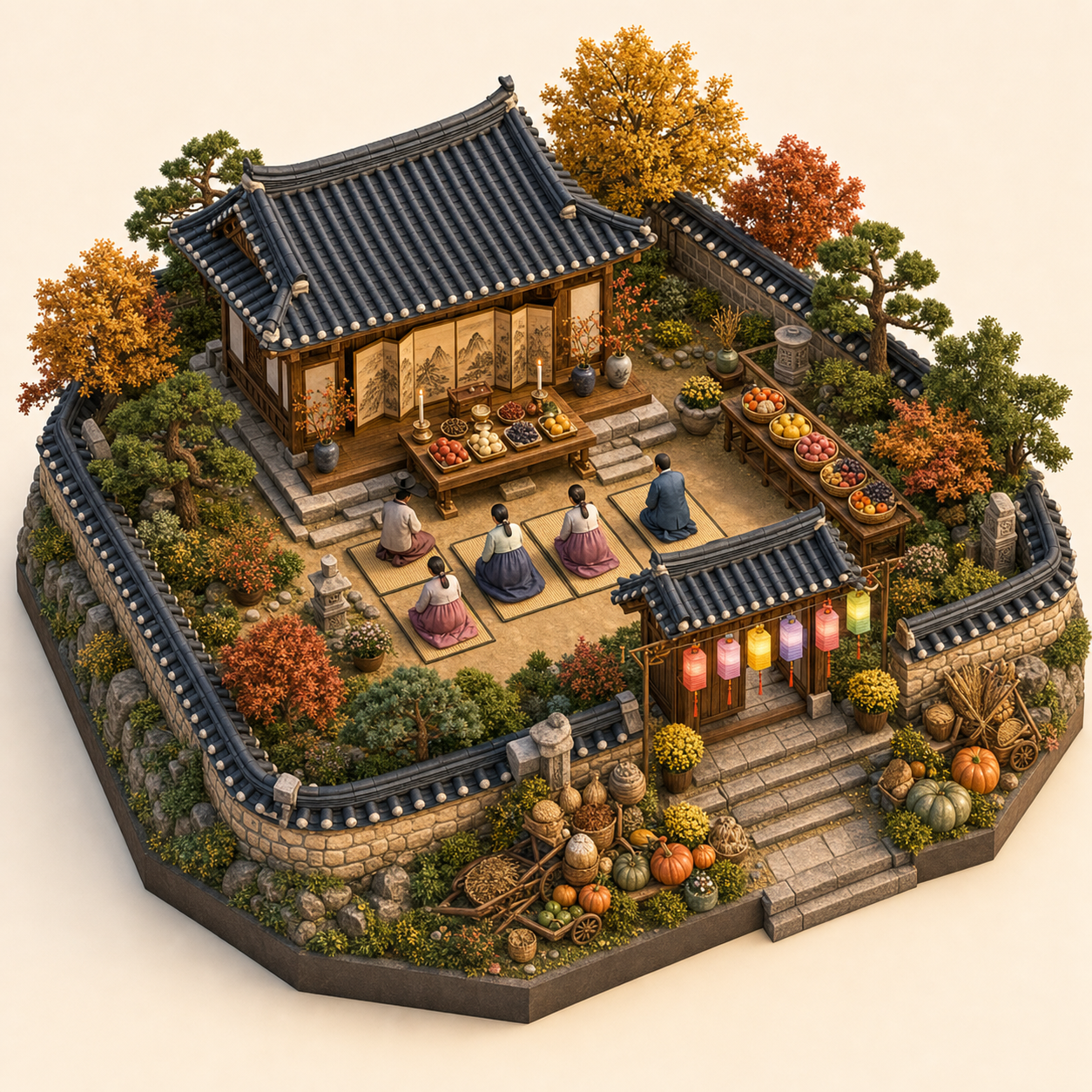
AI-generated cultural illustration for MapDepth; not a documentary photograph.
- Ancestor screen altar: A folding screen, altar, and incense burner place Chuseok's ancestor rites in the courtyard.
- Offering table: An orderly offering table shows the shared ritual-food cue.
- Spirit lantern gate: A small lantern gate suggests the welcoming and sending route within the Gyeonggi courtyard.
- Fruit offering trays: Pears, persimmons, and round plates make Chuseok fruit offerings clear tabletop objects.
- Chanting mats: Mats, a wooden percussion block, and low lamps turn ritual chanting into a visible corner.
Traditions and customs
- welcoming and sending spirits
- lamp offerings
- family remembrance rites
Food and symbols
- offering fruit
- rice cakes
- family feast
- 灯笼
- 供品
- 烛火
When it is celebrated
Korean Chuseok is usually organized around Around the fifteenth day of the seventh lunar month; some regions observe it throughout the month. Month: Aug / Sep
Korean Chuseok
Ghost Festival matters because it turns memory, respect, and shared cultural continuity into a visible cultural system of time, place, family, and public ritual.
Korean Chuseok details
- Celebrates: Korean Chuseok celebrates or commemorates Ghost Festival in South Korea · Gyeonggi-do, centered on welcoming and sending spirits, lamp offerings, family remembrance rites.
- Local roots: The local form developed through South Korea · Gyeonggi-do festival calendars, community organization, and public gathering spaces; timing usually follows Around the fifteenth day of the seventh lunar month; some regions observe it throughout the month.
- Local history: Korean Chuseok turns the wider Ghost Festival theme into visible local practice in South Korea · Gyeonggi-do: welcoming and sending spirits, lamp offerings, family remembrance rites, offering fruit sharing. These activities make the festival a cultural scene shared by households, neighborhoods, and public spaces rather than only a date on the calendar.
- Cultural meaning: This local version strengthens South Korea · Gyeonggi-do community memory, seasonal rhythm, and local identity while preserving the core symbols of Ghost Festival.
Signature practices
- welcoming and sending spirits
- lamp offerings
- family remembrance rites
- offering fruit sharing
- rice cakes sharing
Customs
- welcoming and sending spirits
- lamp offerings
- family remembrance rites
Food
- offering fruit
- rice cakes
- family feast
Music / Dance
- chanting
- ritual drumming
Symbols
- 灯笼
- 供品
- 烛火
FAQ
What is Korean Chuseok?
Korean Chuseok is the local form of Ghost Festival in South Korea · Gyeonggi-do, with customs such as welcoming and sending spirits, lamp offerings, family remembrance rites.
When is Korean Chuseok celebrated?
Korean Chuseok is usually organized around Around the fifteenth day of the seventh lunar month; some regions observe it throughout the month. Month: Aug / Sep.
What traditions are associated with Korean Chuseok?
Common traditions include welcoming and sending spirits, lamp offerings, family remembrance rites, offering fruit, rice cakes, family feast.
Sources
Editorial sources support the festival background, local customs, and cultural notes on this guide.
- Feast · Encyclopaedia Britannica
- Lists of Intangible Cultural Heritage and the Register of Good Safeguarding Practices · UNESCO Intangible Cultural Heritage
Image credits
Image licensing and credit details match the visible image used on this page.
Photo: 대한민국 국군 Republic of Korea Armed Forces · CC BY-SA 2.0 · license: CC BY-SA 2.0 · source page
Continue in the 3D map
Open the map focused on the Gyeonggi-do festival card, with country, region, and festival context preserved.
Continue in the 3D map